











You’re in bed and your body is ready. Your mind isn’t yet.
Today’s conversation goes around one more time, tomorrow drops by, and somewhere in between you remember something you forgot. The harder you try to push it away, the more awake you get.
Switching off your mind with your mind just doesn’t work. Your breathing gets you a lot further.
Your heart rate follows your breath
Put your fingers on your neck and keep breathing calmly. When you breathe in, your heart rate goes up, and when you breathe out, it drops again. Every breath is a little tap on the gas and then a little tap on the brake.
That brake is a nerve that runs from your brainstem to your heart and your organs. It belongs to the part of your nervous system that handles recovery, gets digestion going and brings your heart rate down. When you breathe out, that nerve gets more active, and when you breathe in, less so.
You can use that. Make your exhale longer than your inhale and you get more time on the brake than on the gas, which is exactly where you want to be in the evening.
What 4-7-8 breathing does
Four counts in, hold for seven, eight counts out. That’s the exercise as most people know it, and the ratio is the whole point: you breathe out twice as long as you breathe in.
There’s something else, too. One round takes almost twenty seconds, so you end up at about three breaths per minute. At rest you normally take twelve to sixteen, and you feel that difference in your heart rate pretty quickly.
The counting itself helps as well, by the way. It gives your mind something to do that has nothing to do with tomorrow, and that’s part of why it works.
Where most people go wrong
They force the hold. Seven counts is too long for a lot of people at first, and then you’re lying there fighting your breath when you were trying to relax. In that case, start with four counts in, four counts hold and six counts out, and build it up slowly.
They blow out through their mouth. The original version allows it, but before sleep I’d rather keep it all in the nose. You don’t dry out your mouth, and at the same time you practice the way of breathing you need for the rest of the night.
And they do thirty rounds in a row. More isn’t better here, because if you keep going too long you get lightheaded.
What you can do about it
Here’s how. Lie on your side with the light already off. First breathe out completely once. Then breathe in through your nose for four counts, hold for seven and breathe out through your nose for eight, with your lips gently together.
Do four rounds and then stop. If it feels easy after a week, you can add two more.
Use the same exercise when you wake up at night. That’s exactly the moment your mind switches on, and four rounds is enough to bring your heart rate back down.
Don’t judge it by how fast you fall asleep the first night. This is a skill and you get better at it, so give it a week or two. The evenings you need it most are exactly the evenings it goes least smoothly.
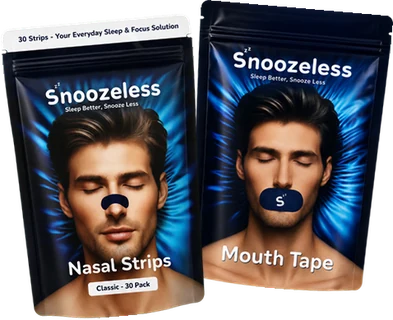
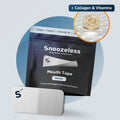
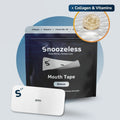
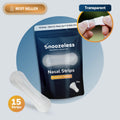
And keep in mind that the exercise ends the moment you drift off. After that your body takes over and breathes the way it’s used to, so fast, shallow breathing simply comes back once you’re asleep. That’s also why the exercise doesn’t work when your nose is blocked. Nasal Strips keep your nasal passage open with a splint that pulls the sides of your nose outward, and mouth tape keeps your mouth closed once you’ve fallen asleep.
This week’s habit
Four rounds as soon as the light goes off. Every night, including the nights you’re already tired and think you don’t need it.
Don’t turn on your phone to count the seconds, just count calmly in your head. It doesn’t have to be exactly four counts :)
After a week, notice how long it takes you to drift off. That’s the first thing that changes.
1% better every night.
Guy Veeke
PS: Want to breathe well at night, too?
Then give the Snoozeless Deep Sleep Duo a try. The combination of Nasal Strips and mouth tape keeps your nose open and your mouth closed, so calm breathing through your nose can actually happen.


