



















I was good at it.
The same ritual every night. Into bed, phone, scrolling. A quick look to see if there was anything on Instagram. One more YouTube video. Quickly answering a message. Checking this, checking that...
Before I knew it, it was 1:15 a.m. I wasn't even looking at anything I cared about anymore. Just... more scrolling and more dopamine. As if my thumb had a mind of its own.
Then I'd put the phone down and try to sleep. And there you are, staring at the ceiling. “Why can't I sleep? It's past 1 a.m. already?!?”
I figured I was just a bad sleeper. That it came with the territory. That some people simply need more time to wind down.
But that wasn't it. There was something I did every night that literally made my body think the day was still going.
What happens in your brain when you scroll
Your body has one hormone that decides whether you get sleepy: melatonin. It's made by the pineal gland in your brain, and it normally starts to rise as soon as it gets dark outside.
Dark is the key word.
Your eyes contain special cells (melanopsin cells) that are extremely sensitive to blue light. Blue light is the dominant type of light in daytime sunlight. The signal these cells send to your brain is simple: it's daytime. Stop making melatonin.
Your phone, your laptop, your TV: they all give off blue light. Not as strong as the sun, but strong enough to confuse your pineal gland. Especially when you're looking at it up close, in a dark room, twenty centimeters from your face.
What does your brain register while you scroll? Daytime, so no reason to get sleepy yet.
Research shows that blue light in the evening can delay melatonin production by one to three hours. In plain terms: your body is only ready to sleep long after you've been lying in bed tossing and turning.
But blue light is only half the story
This was the real eye-opener for me.
Your brain isn't only sensitive to light. It's also sensitive to stimulation.
Every time you scroll, your brain reacts. A funny video, an annoying message, a post that hits home. It doesn't matter what it is. Your amygdala, the part of your brain that processes emotions, lights up. Your prefrontal cortex, the part that thinks and judges, runs at full speed.
You're in a state of low but constant alertness. The exact opposite of what you need to fall asleep.
Sleep needs a calm transition. Your heart rate has to come down. Your body temperature has to drop. Your nervous system has to shift from active to relaxed. That process is called parasympathetic activation, and it takes time. Twenty minutes at least, often longer.
Every notification, every scroll, every video resets that clock.
Your body is trying to land. You keep the plane in the air.
What I changed
I didn't quit my phone in the evening completely, not right away.
What did work: a hard cutoff at 9:30 p.m. Phone away, screens off. Not in a drawer, but in another room. Out of sight, out of mind.
The first week felt uncomfortable. I didn't know what to do with that time. That feeling alone told me enough.
After two weeks, I was sleeping better than I had in years.
The habit for this week
Pick a time. One hour before bed, no more screens. No phone, no laptop, no TV.
Physically put your phone outside your bedroom. Not on silent, not face down on the nightstand. Just outside the door.
One week. Seven evenings. See what happens.
1% better every night.
Guy Veeke
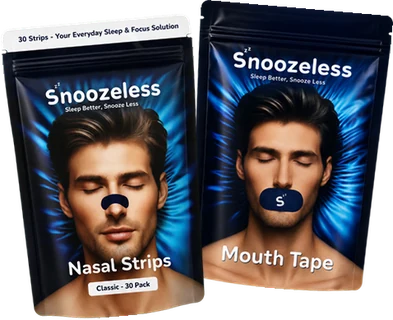
P.S. A big part of lying awake also comes down to how you breathe. If you breathe through your mouth at night, you keep your nervous system active without realizing it. Breathing through your nose gets your body into the rest mode it needs to really let go, and it gets there faster. Our Nasal Strips help keep your nose open, so that switch gets easier: take a look at our Nasal Strips


