













During the day, you can breathe through your nose just fine, but as soon as you're in bed, it feels like one nostril is blocked. You turn onto your other side, it seems better for a moment, and later in the night you wake up anyway.
Often with a dry mouth. Or with the feeling that you never quite slept deeply.
A lot of people think it's "just bad luck." Or that they're coming down with a cold. But that's often not the case.
Something completely normal happens in your body as soon as you lie down.
What changes when you lie down?
When you lie down, the way blood and fluid are spread through your body changes. The lining of your nose is full of tiny blood vessels. When you're lying down, a little more blood flows there, and the lining can swell up slightly.
That's not a defect. That's just how your body works.
The catch: if your nose is naturally a bit narrow, or sensitive to dry air, allergies or changes in temperature, that slight swelling can be just enough to restrict the airflow, and you notice it mostly at night.
What you can do about it
In this situation, a lot of people reach for a nasal spray.
Makes sense. You spray, your nose opens up, you can breathe again.
The catch: most sprays for a blocked nose work by narrowing blood vessels. They make the tiny blood vessels in the lining of your nose shrink for a while, so the swelling goes down.
That brings quick relief, but the effect doesn't last.
If you use a spray like that for more than a few days in a row, your nose can actually come to depend on it. As soon as you stop, the lining swells up even more. That's called rebound congestion (rhinitis medicamentosa). You then need the spray more and more often to get the same open feeling.
For the occasional bad cold it can be fine, but if your nose is blocked night after night, it isn't a lasting solution.
If the real problem is too little space in your nose, it makes more sense to create that space mechanically instead of suppressing the swelling with chemicals.
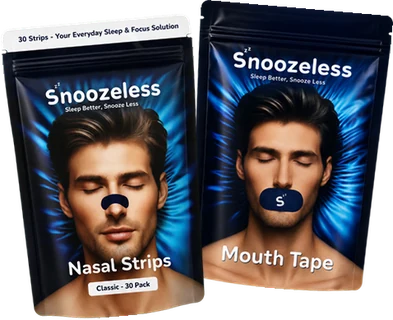
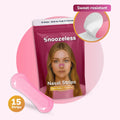
A nasal strip does exactly that. A flexible splint inside the strip gently pulls the sides of your nose outward, so the passage gets wider. No medication involved. You don't change anything about the lining of your nose, you just widen the airway.
Less resistance means:
-
breathing through your nose more easily
-
less chance that your mouth falls open
-
steadier breathing during light sleep
Want to find out if this is what's going on for you?
Give our Nasal Strips a try. You get a 60-night money-back guarantee, so you can take your time and see what they do for your nights.
Every night 1% better sometimes starts with something really simple.
Guy - Snoozeless


