



















You close your bedroom door at night. The window is already shut because it’s getting colder outside, so you sleep for eight hours in a room where no fresh air gets in.
The next morning you have a heavy head and a stale taste in your mouth, and you figure you just didn’t sleep long enough.
Chances are you mostly breathed in your own exhaled air.
What happens in a closed room
Every time you breathe out, you blow carbon dioxide into the room. During the day that doesn’t matter much, because doors open and close and air keeps moving through your home. At night that stops, and the CO₂ builds up in a space of a few dozen cubic meters, with the door closed and the window shut tight.
Outdoor air contains around 400 ppm of CO₂ (parts per million). In a closed bedroom with two people in it, that can easily climb to 2,000 ppm over the course of the night, and sometimes higher. You can’t smell it and you can’t see it, because CO₂ has no odor.
Why your body reacts to it
Your breathing isn’t driven by oxygen. Your brain mainly watches how much CO₂ is in your blood, and that’s the dial it uses to set how deep and how fast you breathe.
When there’s more CO₂ in the air around you, you have a harder time getting rid of it, so your breathing picks up to compensate. You breathe a little faster and shallower and your heart rate creeps up too, while in deep sleep the exact opposite is supposed to happen.
It rarely wakes you up. What you’re left with is a night that does less for you, a heavy head that clears after half an hour outside, and the feeling that your room is stuffy even though it isn’t warm.
The part people miss
This rarely comes alone. With the heating on and the windows closed, the air also gets dry, and dry air irritates the lining of your nose (which makes it swell and narrows your nasal passage).
So two things happen at once. Air that makes you breathe a little faster, and a nose that lets less through than it did during the day. At that point your body takes the path of least resistance, your mouth falls open, and you spend the rest of the night breathing through your mouth.
That’s why a stuffy bedroom in the fall so often ends with a dry mouth in the morning.
What you can do about it
Open your window a crack. A centimeter is enough to keep the air moving all night, and it costs you almost nothing in heat, even in winter.
Can’t open the window because you live on a busy street? Then leave your bedroom door open. Your whole home becomes your air supply, and that’s big enough.
Air the room out with the window wide open for ten minutes before you go to sleep. That helps most if the room has been closed all day, because otherwise you start the night with stale air.
And keep it cool. Around 18°C works for most people, and fresh air from outside gets you there right away.
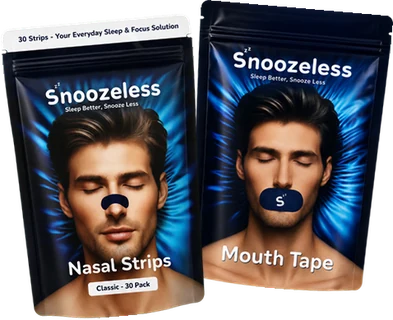
And make sure your nose can do its job. Fresh air doesn’t help much if you can’t get it in, and your nose is never fully open on both sides anyway. Nasal Strips gently pull the sides of your nose outward and keep your nasal passage open with a small splint. Mouth tape keeps your mouth closed, so your body doesn’t switch over halfway through the night after all.
This week’s habit
Open your window a crack before you get into bed. Every night, even when it’s cold outside and it feels wrong.
Keep an extra blanket nearby if you get chilly. You sleep better cool and fresh than warm and stuffy :)
After a few days, pay attention to your first ten minutes after getting up. That heavy, foggy feeling is the first thing to go.
1% better every night.
Guy Veeke
PS: Waking up with a dry mouth even though your window was open?
Then it’s likely how you breathe. Nasal Strips and mouth tape together keep your nose open and your mouth closed, so the hours you sleep actually pay off.


