


















You wake up with a stiff jaw. Sometimes with a headache at your temples, as if you’ve been chewing all night.
Or you hear it from someone else. Your partner, who hears you grinding at night, or your dentist, who says the tops of your molars are wearing flat.
And then you’re told it’s stress. That’s part of the story.
What grinding actually is
Your chewing muscles tense up in short bursts while you sleep. Sometimes you slide your molars back and forth over each other, and sometimes you just clench them together, which you can’t even hear yourself.
The force involved is bigger than anything you can manage while you’re awake. During the day your brain stops you as soon as it hurts, and in your sleep that brake is gone.
Estimates land at about one in ten adults who do it regularly. A good share of them have no idea.
Stress is only half the explanation
Tension definitely plays a part. A day that stays stuck in your body keeps your muscles in a higher gear, including the muscles in your jaw, and in a busy week you grind more.
For a lot of people there’s a second layer underneath, and it hardly ever gets mentioned. Your airway.
What your jaw is trying to fix
When you lie on your back, your lower jaw drops back and your tongue falls back toward your throat. The passage gets narrower and your body has to work harder for the same amount of air.
Pushing your jaw forward does the opposite. It makes room behind your tongue, so the passage opens up again, and that’s exactly the movement you make when you clench and slide.
Researchers who study sleep recordings often see grinding right after a moment when breathing briefly falters. So for some people, grinding seems to be a reflex that keeps the airway open.
That link isn’t the same for everyone, so don’t count on it as the explanation for everything. It does explain something a lot of people run into, though: a night guard protects their teeth while the grinding just carries on.
What makes it worse
Alcohol in the evening, caffeine late in the day, smoking and too little sleep are all on the list.
Mouth breathing belongs there, too. With your mouth open, your tongue loses its spot against the roof of your mouth and your jaw drops back, so your chewing muscles end up doing the job your tongue normally does.
What you can do about it
See your dentist if your teeth are wearing down. A night guard protects your teeth, and that’s worth the money, even if the cause underneath stays.
See your doctor if your partner notices pauses in your breathing, if you wake up with headaches or if you’re really sleepy during the day. Those three together are signs of sleep apnea, and you want that checked.
Sleep on your side and put a pillow behind your back so you don’t roll back over. On your side, your jaw stays in place and your tongue is less likely to slide back.
Have your last alcohol three hours before bed and your last caffeine around noon.
Rest your tongue against the roof of your mouth when you lie down, with your back teeth apart. That’s the position where your jaw muscles have nothing to do.
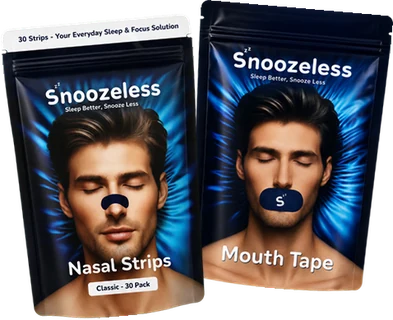
And make sure you can keep breathing through your nose, because that’s where the whole chain starts. Nasal Strips pull the sides of your nose outward and keep your nasal passage open with a splint. Mouth tape keeps your mouth closed, so your tongue stays in its spot and your jaw doesn’t go to work in the middle of the night.
This week’s habit
Do a jaw check every morning. Bite down gently once and notice whether your jaw feels stiff or sore.
Tonight, lie on your side with your tongue against the roof of your mouth and your back teeth apart. That’s all you need to change.
1% better every night.
Guy Veeke
PS: Do you grind mostly on the nights you wake up with a dry mouth?
Then your breathing is the lead to follow. The combination of Nasal Strips and mouth tape keeps your nose open and your mouth closed, so your jaw gets left alone.


